
Signs You Need Dryer Vent Cleaning in Georgia, GA — Before the Fire Risk Escalates
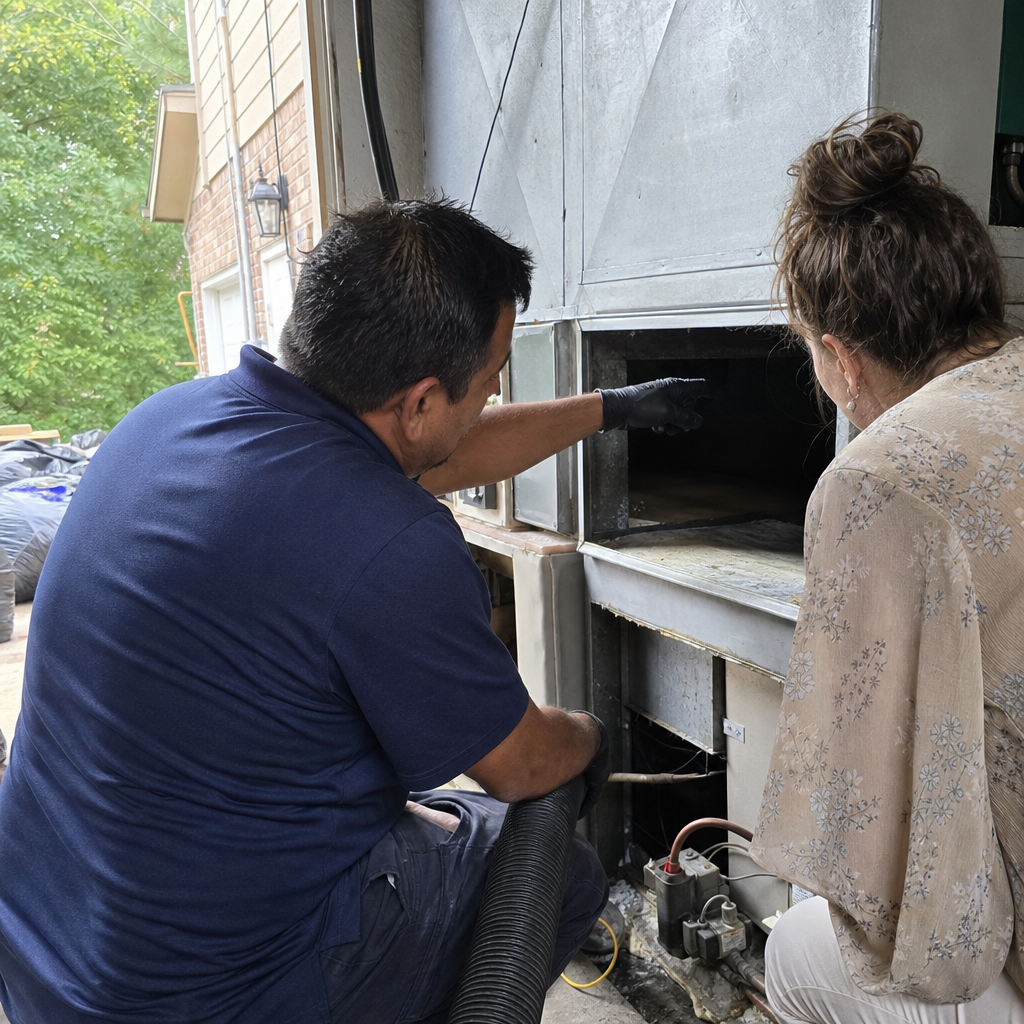
Clothes taking two cycles to dry is not an early warning sign — it’s evidence that lint accumulation has already reached NFPA-elevated fire risk levels. In Georgia homes, the first indicators are subtler: a laundry room that runs noticeably warmer than the rest of the house during cycles, faint musty or burnt odors in the first minutes of drying, and an exterior vent cap that stops pushing visible steam even on cold mornings. If you’re noticing any of these, your vent is already restricting airflow past the point where DIY cleaning can safely reach. Call (877) 565-7296 for a free assessment — we bring 20 years of hands-on experience and professional-grade equipment to every job.
Why Georgia’s Housing Stock Hides Dryer Vent Problems Longer Than Other Regions
We’ve spent two decades crawling through attics and chasing ductwork leaks in Georgia homes, and here’s what separates this market: slab foundations and interior wall routing. Unlike homes in the Northeast or Midwest where a dryer often backs directly to an exterior wall with a 6-foot run, Georgia’s post-1960s housing — especially in neighborhoods like Decatur, Tucker, and the Gwinnett suburbs — frequently routes dryer vents 20-plus feet through interior walls before terminating at a soffit or gable end.
That geometry changes everything about how lint behaves. In a short exterior run, lint accumulates at the termination cap and the first elbow. You can often see the problem, and a basic brush kit from the hardware store might actually help. In Georgia’s long horizontal runs, lint compresses under its own weight across the full span of the duct. It doesn’t just collect at bends — it packs into a dense, layered obstruction that reduces diameter incrementally, like arterial plaque. By the time drying cycles double in length, that obstruction is often 60-80% of the duct’s cross-section.
Scott Gray, Owner & Lead Technician at Everest Air Duct Cleaning Service Georgia, got his start in HVAC fundamentals at Georgia Piedmont Technical College, where a hands-on instructor drilled into him that the air inside a house tells you everything about how well it’s being maintained. That training shows up in how we diagnose these systems — we don’t just clear what we can reach; we trace the full run to find where the compression is worst.
The Early-Stage Signs Most Homeowners Miss — and What They Actually Mean
The standard advice says “your dryer takes too long” is the sign to watch for. By then, you’re already behind. Here are the pre-failure indicators we look for on every inspection, and what they reveal about where the restriction lives in your system.
Your laundry room heats up during cycles — even with the door open
A properly venting dryer pushes nearly all its exhaust heat outside. When airflow is restricted, that heat backfills into the laundry space. In Georgia’s already-humid summers, this is easy to dismiss as “just summer,” but it’s not. We’ve measured laundry room temperatures 12-15°F above ambient during cycles in homes where the vent was 70% obstructed. The heat has to go somewhere, and it’s not making it to the termination cap.
Faint musty or burnt smell in the first 3-5 minutes of drying
This is moisture trapped in lint beginning to re-evaporate and overheat. The musty note comes from organic lint fibers holding humidity; the burnt edge comes from lint beginning to char at hot spots where airflow is most restricted. In Georgia’s climate, where outdoor humidity regularly hits 85% in July and August, this moisture-loading happens faster than in drier regions. That smell is your vent’s check-engine light — ignore it, and the next signal is the smoke detector.
The exterior cap isn’t exhausting visible steam on cold mornings
This is the single most reliable early indicator we teach homeowners to check. On a morning below 50°F, a properly venting dryer should produce a visible steam plume at the exterior cap for the full cycle. If you see weak, intermittent, or no exhaust — or if the cap flapper barely moves — the restriction is substantial. In Georgia’s winter temperature swings, this test works reliably from November through March.
Your lint trap collects less lint than it used to
This one surprises people. A full lint trap is actually a sign of healthy airflow — lint is being carried to the screen as designed. When your trap shows noticeably less lint after a full load, the restriction is downstream. Lint is impacting inside the duct rather than reaching the trap, which means the obstruction is past the blower fan and growing. We’ve pulled pounds of compressed lint from ducts in homes where the homeowner proudly showed us their “clean” lint screen.
Condensation staining or persistent humidity around the vent termination
Unique to Georgia’s long interior runs: when lint traps exhaust moisture inside the duct, that moisture condenses on the cooler surfaces of the termination cap and surrounding soffit or siding. We see this constantly in Dunwoody and Sandy Springs homes built in the 1980s and 90s — brown staining on vinyl soffits, peeling paint near gable-end terminations, or a laundry room that feels muggy despite the dryer running. The lint isn’t just blocking air; it’s acting as a sponge, holding humidity in the system where it breeds mold and accelerates corrosion.
How Georgia’s Climate and Construction Create a Different Obstruction Profile
We don’t use the same approach on a 6-foot exterior run that we use on a 25-foot slab foundation run. The equipment and technique have to match the problem.
| Run Type | Typical Georgia Location | Obstruction Pattern | Equipment We Use |
|---|---|---|---|
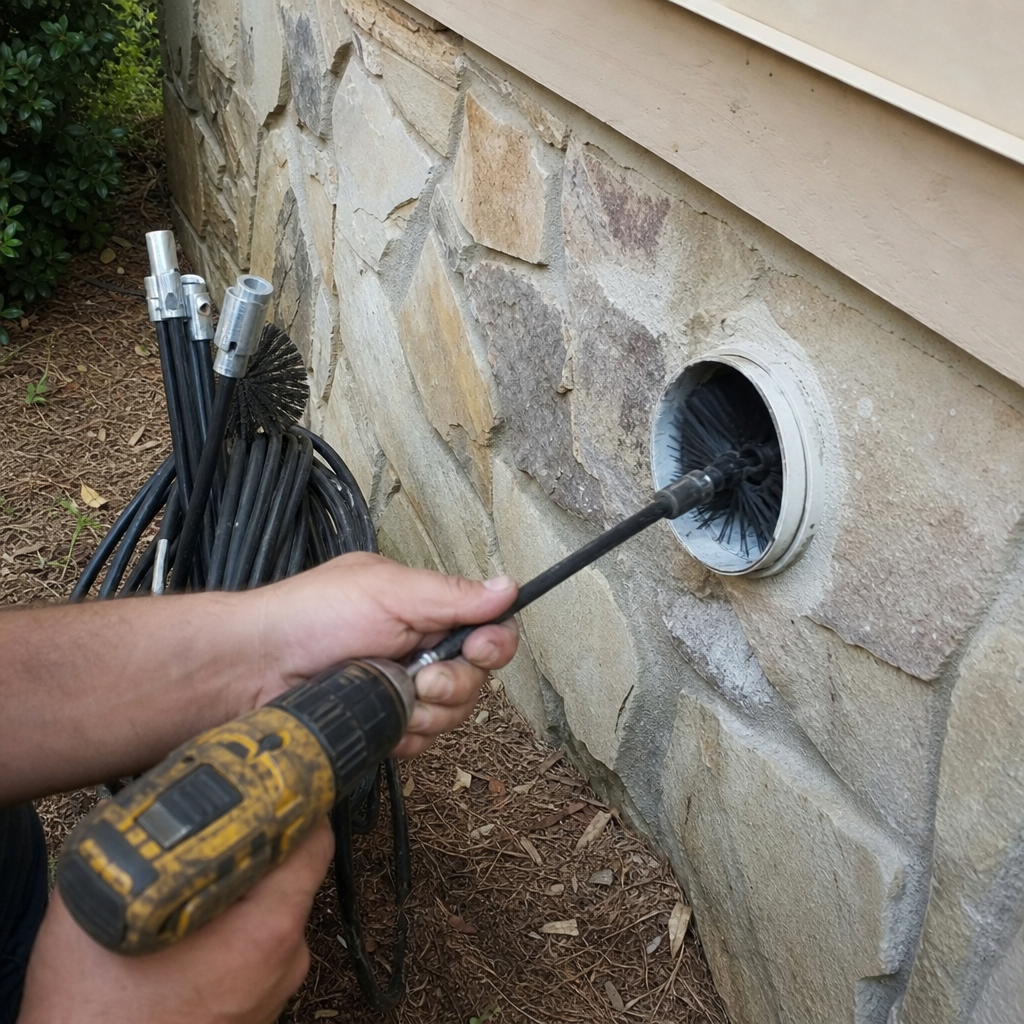
| Short exterior (under 10 ft) | Older Decatur bungalows, some 1970s ranch homes | Lint accumulation at termination and first elbow | Rotobrush contact-cleaning with forward/reverse agitation |
| Long interior horizontal (15-30 ft) | Slab homes in Gwinnett, Forsyth, Fulton suburbs | Compressed lint layer across full span; dense packing at low points | Nikro HEPA vacuum extraction with high-velocity reverse airflow; Rotobrush for residual agitation |
| Vertical through-wall (10-20 ft) | Two-story homes in Alpharetta, Johns Creek | Lint falls and compacts at bottom elbow; moisture damage at termination | Combined Rotobrush and Nikro extraction; inspection camera to verify clear |
| Flexible transition duct (3-8 ft) | All home types — most common failure point | Kinking, crushing, or internal lint adhesion to ribbed surface | Replacement with rigid or semi-rigid duct; never re-use damaged flex |
Our Dryer Vent Cleaning service starts with a full run inspection using a borescope camera — we show you what we’re seeing before we quote. In Georgia’s long-run homes, we regularly find sections where the previous homeowner’s DIY brush kit pushed lint into a dense plug rather than removing it. That “cleaning” actually made the fire hazard worse by compressing the obstruction.
What Happens When We Find Damage During Cleaning — and Why It Matters
Here’s where Everest’s full-service scope separates us from vent-only operations. In roughly one of every four Georgia homes we service, the cleaning reveals a crushed section, disconnected joint, or improper material that created the obstruction in the first place.
Slab-foundation vents often pass under doorframes or through structural channels where the duct has been compressed during a renovation, or where a previous owner used flexible transition duct for the entire run against code. In humid Georgia summers, we’ve found galvanized ducts corroded through at low points where trapped moisture sat for years. A cleaning-only company identifies this, shrugs, and leaves you with a half-solved fire hazard.
We handle the full scope: cleaning, repair, sealing, and sanitizing. If we find a crushed section where your vent passes under the laundry room doorway, we replace it with proper rigid duct and seal the joints. If the termination cap is corroded or improperly screened (a common issue that lets birds and rodents enter), we install a proper termination with a backdraft damper. From dirty ducts to repaired, sealed, and sanitized — we handle it without bringing in a second contractor.
Our equipment roster reflects this capability: Rotobrush contact-cleaning systems for mechanical agitation, Nikro HEPA vacuums for contained extraction, and Abatement Technologies air scrubbers when we’re working in occupied spaces. These are the same tools we use in commercial remediation work — not consumer-grade attachments on a shop vacuum.
What Professional Dryer Vent Cleaning Costs in Georgia — and What Affects the Price
Pricing depends on run length, accessibility, and what we find. Here’s the transparent breakdown we give every caller:
| Service Component | Typical Range in Georgia Market |
|---|---|
| Standard dryer vent cleaning (single-family, run under 15 ft) | $150 – $225 |
| Extended run cleaning (15-30 ft, interior wall routing) | $225 – $325 |
| Multi-vent or commercial units | $275 – $450 |
| Duct repair/replacement (crushed or disconnected section found during cleaning) | $75 – $200 additional |
| Proper termination cap replacement | $45 – $95 additional |
We don’t quote over the phone for runs we haven’t seen — anyone who does is guessing. What we do guarantee: free estimates with camera inspection, upfront pricing before any work begins, and no charge if we find your vent is genuinely clear. That last part is apparently rarer than it should be.
433 neighbors have rated us 4.9 stars — the numbers speak for themselves. Most of our customers in the Decatur area know Scott by first name before the job is done, and his teenage son has already started tagging along on weekend jobs. That’s the kind of operation this is.
Key Takeaways: When to Call and What to Expect
- Don’t wait for slow drying. Heat backfill, musty odors, and weak exterior exhaust are your real early warnings.
- Test your vent on the next cold morning. No visible steam means restriction is already significant.
- Less lint on your trap is worse, not better. It means lint is packing downstream.
- Georgia’s long interior runs need professional-grade extraction. DIY brush kits often compress obstructions rather than clearing them.
- Damage found during cleaning should be fixed same-visit. A disconnected duct “cleaned” is still a fire hazard.
If your ducts haven’t been looked at in a decade, you don’t have an air quality problem — you have an air quality certainty.
FAQs
Most single-family homes in Georgia fall between $150 and $325 depending on run length and routing complexity — see our 2026 dryer vent cleaning cost guide for Georgia for a full breakdown. Extended interior runs common in slab-foundation homes — 20-plus feet through walls — run toward the higher end due to the equipment and time required for thorough extraction. Call (877) 565-7296 for a free, no-pressure estimate with camera inspection — we show you the obstruction before we quote.
For a short, straight exterior run with visible termination, a basic brush kit may help — though it rarely removes adhered lint completely. For Georgia’s typical long interior runs, DIY attempts usually push lint into denser plugs or damage flexible duct sections, creating worse fire hazards. For Best Dryer Vent Cleaning in Georgia, GA, professional service with Rotobrush agitation and Nikro HEPA extraction runs $150–$325 and includes inspection, verification, and repair of damage found — which DIY cannot address. Call (877) 565-7296 to discuss your specific routing.
Every 12–18 months for typical households; every 6–12 months if you have pets (increased hair and dander load), large-family laundry volume, or a run exceeding 20 feet. Georgia’s humidity accelerates lint compaction and moisture retention in long interior runs, so the upper end of standard guidance — 18 months — is too long for most local homes. We recommend annual inspection with camera verification, cleaning only when actually needed. Call (877) 565-7296 to schedule.
Yes — and we do in roughly 25% of Georgia homes we service. Long interior runs passing under doorframes or through structural channels frequently show damage that created the obstruction. We carry rigid duct, proper fittings, and termination caps on every truck, so repair and sealing happens same-day rather than leaving you with a half-solved hazard. This is why Everest handles the full scope from cleaning through repair — no second contractor needed. Call (877) 565-7296 for assessment.
Ready to Have Your Vent Properly Inspected?
If you’d rather have it looked at than guess, Everest Air Duct Cleaning Service Georgia offers Affordable Dryer Vent Cleaning in Georgia, GA with a no-pressure assessment — we’ll run a camera, show you what we’re seeing, and quote upfront before any work begins. Two decades of crawlspace-level experience goes into every inspection. Call (877) 565-7296 for your free estimate.
Written by Scott Gray, Owner & Lead Technician at Everest Air Duct Cleaning Service Georgia, serving Georgia, GA.