
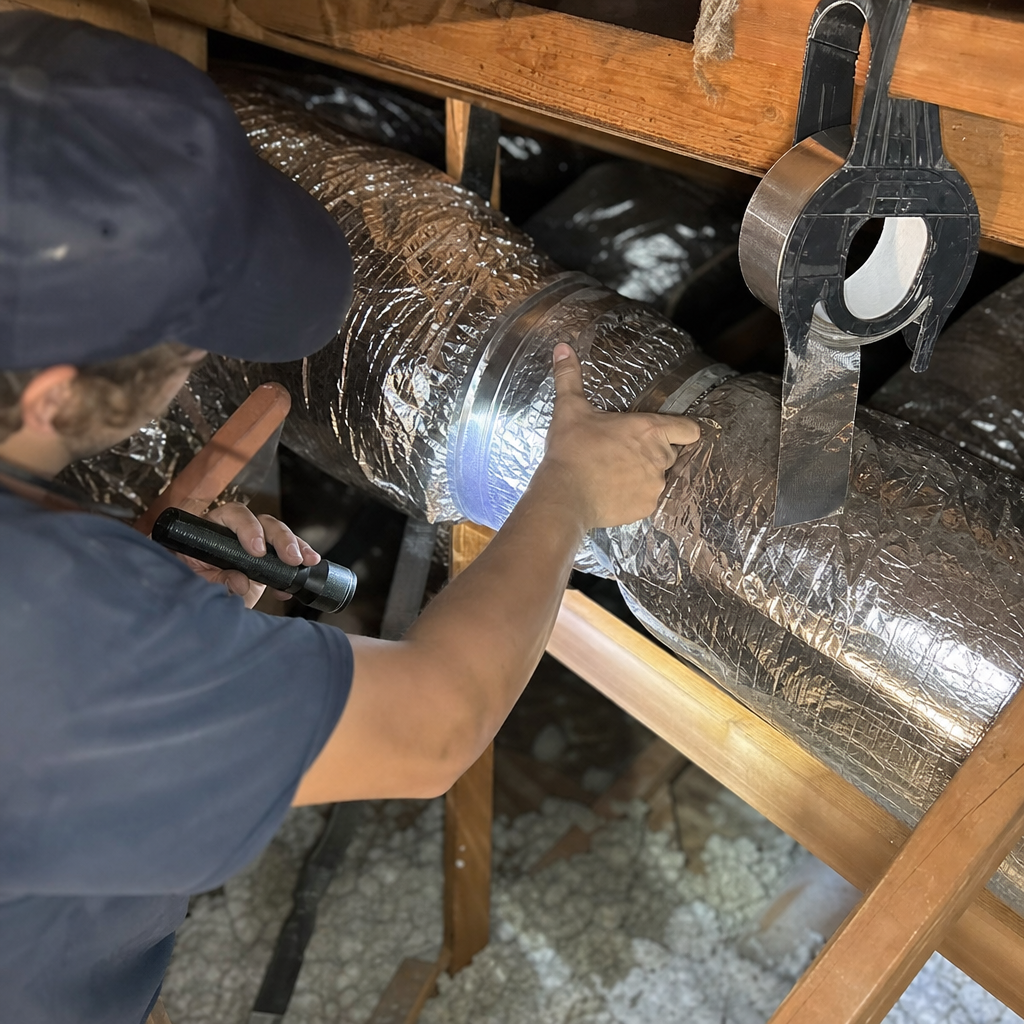
How Much Does Duct Repair & Sealing Cost in Atlanta?
Duct Sealing Cost in Georgia, GA typically runs between $300 and $1,200 for most residential homes, with the average job landing around $500–$700 when combining minor repairs and Aeroseal or mastic sealing on a standard single-story house. Larger homes, heavily deteriorated ductwork, or systems with multiple disconnected runs can push the total toward $1,500–$2,500. Most Atlanta homeowners see the job completed in a single visit — no callbacks, no subcontractors.
Duct Repair & Sealing Cost Breakdown (2026)
Here’s what the Atlanta market looks like line-by-line in 2026. These ranges reflect real jobs across neighborhoods like Buckhead, Decatur, Sandy Springs, East Atlanta Village, Marietta, and Smyrna — not national averages padded with coastal data.
| Service / Repair Type | Typical Atlanta Price Range | Notes |
|---|---|---|
| Duct inspection & assessment | $75–$150 | Often credited toward repair cost when work is booked |
| Mastic sealant application (per duct section) | $150–$350 | Best for accessible joints in unconditioned attics and crawlspaces |
| Foil-tape sealing (per zone) | $100–$250 | Used on minor leaks at collar joints; labor-intensive in tight crawlspaces |
| Aeroseal duct sealing (whole-system) | $1,200–$2,500 | Pressurized aerosol polymer; seals leaks inside the duct wall from within |
| Disconnected duct reconnection (per joint) | $75–$175 | Common in older Buckhead and Grant Park crawlspace systems |
| Flex duct replacement (per linear foot) | $12–$28 | Collapsed or kinked flex runs are frequent in Atlanta’s humid attics |
| Sheet metal duct section replacement | $200–$600 per section | Rust damage from condensation; common in crawlspace-installed systems |
| Full duct system re-sealing (whole home, 2,000–3,000 sq ft) | $600–$1,400 | Comprehensive mastic/foil treatment, multiple supply and return runs |
| Combined cleaning + sealing package | $700–$1,600 | Cleaned first so sealant bonds properly to duct surfaces |
What Pushes the Price Up — or Down
Atlanta’s climate does most of the damage. Summer humidity here routinely sits at 70–85%, and that moisture works its way into unconditioned attics and crawlspaces year-round. The result: flex duct insulation degrades faster than the national average, mastic around collar joints cracks as the material heats and cools with Georgia’s wide seasonal swings, and sheet metal sections in crawlspace systems can show rust within 10–12 years of installation.
The biggest cost driver is access. A two-story Buckhead colonial with sealed attic space and supply runs tucked behind drywall costs two to three times more to seal than a single-story ranch in Smyrna with an open, walkable attic. When our team has to pull registers and work blind through ceiling cavities, labor time climbs accordingly. Homes built before 1990 — common throughout Decatur, East Atlanta Village, and the Virginia-Highland corridor — often have unsealed duct board systems that require more surface preparation before any sealant will bond correctly.
Conversely, jobs get cheaper when the ductwork is well-organized, recently cleaned, and physically accessible. That’s one reason we recommend pairing our Duct Repair & Sealing services with a duct cleaning appointment: clean surfaces take sealant better, the technician is already inside the system, and you’re not paying double mobilization costs.
What Affects Duct Repair & Sealing Pricing in Atlanta
- Home size and duct volume: A 1,400-square-foot Kirkwood bungalow might have 8–10 supply registers; a 4,000-square-foot home in Sandy Springs could have 24 or more, each with collar joints and branch connections that need inspection and sealing. More duct surface means more labor hours and more material.
- Attic vs. crawlspace vs. basement installation: Atlanta’s older homes split almost evenly between crawlspace and attic duct runs. Crawlspace work — common throughout East Atlanta Village, Edgewood, and Candler Park — takes longer due to limited clearance and often involves moisture-related damage that attic systems don’t see at the same rate.
- Duct material age and type: Flexible duct installed before 2000 often uses foil-and-fiberglass construction that has already delaminated. Older duct board (fiberboard) common in 1970s–1980s Atlanta builds absorbs moisture and crumbles at the joints, requiring more extensive preparation before sealing can happen effectively.
- Number of disconnected or collapsed sections: In crawlspaces across South Atlanta neighborhoods like Mechanicsville and Pittsburgh, we regularly find duct runs that have simply pulled free from their collars — sometimes for years without the homeowner knowing. Each disconnected section needs to be physically reconnected, supported, and sealed before the system functions properly.
- Severity of leakage: A duct system leaking 15% of conditioned air requires a different scope of work than one leaking 35%. A pressure test (duct blaster test) at the start of the job gives us a baseline leakage rate and helps us scope the work accurately — so you’re not paying for sealing that isn’t needed or missing leaks that are costing you real money every month on your Georgia Power bill.
- Whether cleaning is done first: Sealant bonds to clean metal and duct board surfaces significantly better than to dusty, debris-coated ones. If the ducts haven’t been cleaned in several years — or ever — combining a Rotobrush contact-clean and Nikro HEPA extraction with the repair appointment produces better sealing results and a better long-term bond.
Atlanta-Specific Factors You Won’t Read on a Generic Price Guide
Most national price guides ignore the specifics that actually move the needle in Atlanta. A few things worth knowing:
Georgia Energy Code and duct leakage standards: Under the Georgia Energy Code (based on the 2021 IECC), new duct systems in conditioned and unconditioned spaces must meet specific leakage thresholds verified by post-construction testing. If you’re repairing or replacing ductwork as part of a permitted renovation in Atlanta, your contractor should be aware of these thresholds. For existing systems being sealed rather than replaced, permit requirements typically don’t apply — but understanding the code target gives you a useful benchmark for what “properly sealed” actually means.
Georgia Power rebates: Georgia Power’s Home Energy Improvement program has historically offered rebates for duct sealing work that meets verified leakage reduction thresholds. The specific rebate amounts and qualification criteria change annually, so it’s worth checking directly with Georgia Power before your appointment — a qualified duct sealing job might offset part of the cost.
Crawlspace vapor barrier interaction: In Atlanta’s humid climate, unconditioned crawlspaces with inadequate vapor barriers create a moisture environment that accelerates duct joint failure. We see this constantly in homes south of I-20 and throughout older Decatur subdivisions. Sealing the ducts without addressing a failing vapor barrier is a short-term fix — the moisture will work its way back into the joint within a few seasons. Our inspection process flags this so you’re making a complete repair, not just a cosmetic one.
How to Save on Duct Repair & Sealing
The biggest savings come from Affordable Duct Repair & Sealing in Georgia, GA with accurate scoping upfront. A free in-home estimate — not a ballpark from a website form — is the only way to know exactly which sections need repair, which need sealing, and which are actually fine. Call (877) 565-7296 and we’ll schedule Scott Gray to walk through the system directly. Twenty years of crawlspace-level experience means we can distinguish a joint that needs immediate attention from one that just needs monitoring — and we won’t pad the scope to cover a slow day.
- Bundle cleaning and sealing in one appointment. Mobilization cost is shared, surfaces are cleaned before sealant goes on, and the total is less than two separate visits. For most Atlanta homes, a combined cleaning-and-seal job runs $700–$1,600 versus $900–$2,000+ if booked separately.
- Ask about a duct leakage test before committing to Aeroseal. Aeroseal is the right tool when leakage is diffuse and widespread, but for localized joint failures, mastic sealing at a fraction of the cost often achieves the same result. We’ll tell you which approach fits your system — not which one has a higher ticket price.
- Check Georgia Power rebates before scheduling. Verified leakage reduction can qualify for utility incentives. We document pre- and post-job leakage rates, which is exactly what Georgia Power’s rebate process requires.
- Don’t delay small repairs. A single disconnected flex duct joint losing conditioned air into a crawlspace costs roughly $75–$175 to reconnect and seal. Left unaddressed for two Atlanta summers, the moisture infiltration and energy loss typically costs far more than the repair in compounding utility bills and secondary damage.
- Get a real estimate, not a phone quote. Any contractor who quotes duct sealing over the phone without seeing the system is guessing. Free in-home estimates protect you from low bids that balloon on-site and high bids padded with unnecessary scope.
FAQs — Duct Repair & Sealing Cost in Atlanta
How much does duct sealing cost in Atlanta for an average-size home?
For a 1,800–2,500 square foot Atlanta home with accessible ductwork and moderate leakage, duct sealing typically runs $450–$900 using mastic or foil-tape methods. Whole-home Aeroseal treatment on the same size home runs $1,400–$2,200. The right method depends on where the leaks are and how distributed they are across the system — that’s exactly what the free inspection determines. Call (877) 565-7296 for an exact quote; the estimate is free and Scott Gray will do the assessment himself.
Is duct sealing worth it in Atlanta’s climate?
Yes — and Atlanta’s climate makes the case more clearly than most markets. A duct system losing 20–30% of conditioned air into an unconditioned attic or crawlspace is effectively running your HVAC system at 70–80% efficiency on 95-degree Atlanta summer days. DOE research puts the average energy savings from duct sealing at 20–30% on HVAC operating costs; in Atlanta where cooling season runs five-plus months, that translates to real money on every Georgia Power bill. For allergy sufferers, sealed ducts also stop pulling unconditioned crawlspace air — mold spores, dust, and particulates included — back into the living space.
How long does duct sealing last?
Properly applied mastic sealant on clean duct surfaces lasts 10–15 years on average; many applications in moderate-humidity environments last longer. Aeroseal polymer bonds are rated by the manufacturer for the life of the duct system. In Atlanta’s high-humidity environment, the durability of any sealant is tied closely to whether the underlying moisture source — typically a crawlspace vapor barrier issue or an HVAC condensate problem — is also addressed. We flag those conditions during every inspection.
Can I seal my own ducts with duct tape from the hardware store?
Standard duct tape — the silver cloth-backed type sold at hardware stores — fails in the temperature and humidity cycles that Atlanta attics and crawlspaces produce, often within 1–2 years. It’s not the same as UL 181-rated foil tape, and neither is a substitute for mastic compound on high-movement joints. More practically: the sections of ductwork that need sealing most urgently are usually the ones that are hardest to physically reach. Attempting repairs in a confined crawlspace without proper lighting, tools, and experience creates both safety hazards and the risk of dislodging connections that were still holding. A professional Duct Repair & Sealing Near Me in Georgia, GA is the cost-effective approach in this climate. Call (877) 565-7296 for a free estimate.
Does Everest Air Duct Cleaning handle both the cleaning and the sealing, or do I need a separate contractor?
We handle the full scope in-house — no referrals, no subcontractors. Duct Repair & Sealing in Georgia is one of our five core services, and it’s performed by the same team that does the cleaning. Scott Gray has worked every job for 20 years; when we find damaged or leaking ductwork during a cleaning appointment, we assess it on the spot and scope the repair the same day. That’s the advantage of an owner-operated specialist over a generalist HVAC company where duct work is an afterthought.
What’s the difference between duct repair and duct sealing, and do I need both?
Duct repair means physically reconnecting disconnected sections, replacing collapsed flex runs, or patching damaged duct board — structural fixes. Duct sealing means applying mastic, foil tape, or Aeroseal polymer to close air gaps at joints and seams — leakage control. Many Atlanta homes need both: a disconnected run gets reconnected (repair) and then sealed at the joint (sealing). Others only need sealing at collar joints that have dried out and cracked. The inspection tells us exactly which scope applies to your system, and the estimate breaks it out line by line.
Key Takeaways
- Duct sealing in Atlanta costs $300–$1,200 for most homes using mastic or foil-tape methods; Aeroseal whole-home treatment runs $1,200–$2,500.
- Atlanta’s high humidity, wide temperature swings, and aging crawlspace duct systems make leakage more common — and more costly — than in drier markets.
- Combining a cleaning appointment with repair and sealing saves money on mobilization and produces better sealant adhesion.
- Georgia Power rebates may offset part of the cost for verified leakage reduction — ask before scheduling.
- Scott Gray performs the inspection and the repair personally — 433 Atlanta customers have rated that combination 4.9 stars.
- Free estimates are available at (877) 565-7296; no obligation, no pressure, no phone-quote guessing.
Get a Free Estimate from Everest Air Duct Cleaning in Atlanta
If your energy bills have been climbing, your system is struggling to hold temperature, or you’ve noticed dusty or musty air from your registers, leaking ductwork is a likely culprit — and it’s a fixable one. Scott Gray has spent 20 years diagnosing and repairing Atlanta duct systems from the inside out, and 433 neighbors have trusted that work enough to leave a 4.9-star review. We use professional-grade equipment — Rotobrush contact-cleaning systems, Nikro HEPA extraction — and we back every repair with honest, upfront pricing before a single screw turns.
Visit our home to learn more about what Everest Air Duct Cleaning does, or call (877) 565-7296 right now to schedule your free in-home estimate. We serve Atlanta and the surrounding metro, and we’ll give you a written scope of work before any repair begins. No surprises on the invoice — just clean, properly sealed ductwork and a system that performs the way it was designed to.
Pricing reflects the Atlanta market as of 2026. Everest Air Duct Cleaning Service Georgia offers free estimates — call (877) 565-7296.
Written by Scott Gray, Owner & Lead Technician at Everest Air Duct Cleaning Service Georgia, serving Atlanta since 2005.