
Last updated July 11, 2026
How to Hire a Air Duct Cleaning Contractor in Atlanta: A Step-by-Step Guide
The Better Business Bureau’s Atlanta chapter has logged more complaints against duct cleaning companies than any other home services trade in the metro — almost all of them share the same pattern: a low advertised price, then a technician who “finds” mold or contamination requiring hundreds more on-site. In twenty years of crawling through Atlanta attics and crawlspaces, we’ve watched this bait-and-switch playbook destroy trust in our entire trade. This guide gives you the exact questions and verification steps to separate legitimate operators from pressure-sales crews before anyone sets foot in your house. You’ll learn how to check real credentials, spot red flags in phone conversations, read contract language, and demand measurable proof of a job done right.
Quick Answer
Hiring a legitimate air duct cleaning contractor in Atlanta means verifying NADCA membership independently, asking three specific phone questions about pricing structure and equipment, demanding a written scope before arrival, and requiring measurable deliverables like CFM readings and camera documentation in your contract. Avoid any company advertising whole-house specials under $100 — these are almost universally bait-and-switch operations in the Atlanta market.
Table of Contents
- Why Atlanta’s Duct Cleaning Market Is Different
- How to Verify Real Credentials (Not Just Logos on a Truck)
- The Three Phone Questions That Expose Bait-and-Switch Operations
- What a Legitimate Pre-Job Walkthrough Looks Like
- How to Evaluate a Before/After Proposal
- Contract Language to Require Before Signing
- Common Mistakes to Avoid
- When to Call a Professional
- Frequently Asked Questions
- The Bottom Line
Why Atlanta’s Duct Cleaning Market Is Different
Atlanta’s climate creates perfect conditions for duct contamination — and for dishonest contractors to exploit homeowner anxiety. Our hot, humid summers mean condensation builds in HVAC systems eight months of the year. Pollen season blankets the metro from March through May, coating intake vents with yellow-green residue that looks alarming to the untrained eye. Combine this with Atlanta’s explosive suburban growth — new construction in Forsyth, Henry, and Paulding counties with ducts full of drywall dust and debris — and you’ve got a market where scare tactics work.
The $49 whole-house special is Atlanta’s signature scam. These operations typically run call centers outside Georgia, dispatch subcontracted crews with shop-vacs, and train technicians in upselling, not cleaning. We’ve been called to homes in Buckhead, Decatur, and Sandy Springs where the “cleaning” took twenty minutes and left fiberglass insulation torn, registers damaged, and the homeowner $400 lighter after “mold treatment” that was actually just scented spray.
Georgia’s regulatory environment doesn’t protect you as much as you’d expect. The Everest Air Duct Cleaning Service Georgia home team explains this regularly to homeowners: state HVAC licensing covers mechanical work on heating and cooling equipment, but duct cleaning sits in a gray area. A contractor can hold a valid Conditioned Air Contractor license and have never cleaned a duct in their life. NADCA certification — the National Air Duct Cleaners Association — is voluntary, which makes verifying it yourself essential rather than trusting a logo on a website.
Atlanta’s specific challenges also include older homes in Virginia-Highland, Inman Park, and Grant Park with original galvanized ductwork that requires different handling than modern flex-duct. Original systems in these neighborhoods often have asbestos-containing duct tape or insulation that an untrained crew will disturb. A legitimate contractor should ask your home’s age and construction type before quoting.
How to Verify Real Credentials (Not Just Logos on a Truck)
NADCA membership is the closest thing to a legitimate credential in our industry, but companies imply it guarantees quality when it actually just means they paid dues and signed a code of ethics. Here’s what to check:
- Verify directly at NADCA.com. Use the “Find a Professional” tool and confirm the company’s exact legal name appears. Some operators claim “NADCA-certified technicians” when only the company owner holds membership, or worse, they’ve let membership lapse.
- Check the specific certification held. ASCS (Air Systems Cleaning Specialist) is the individual technician certification. VSMR (Ventilation System Mold Remediator) requires additional training. Ask who on your job holds these — if the answer is vague, you’re not getting a certified technician.
- Confirm Georgia business registration. Search the Secretary of State’s corporations database. Legitimate Atlanta contractors are registered entities with a physical Georgia address, not a PO box or out-of-state headquarters.
- Request proof of general liability and workers’ compensation insurance. We carry both, and any honest contractor will provide certificates of insurance naming you as additional insured upon request. The $49 specials rarely carry adequate coverage — if a technician falls through your ceiling in a Sandy Springs attic or gets injured in your Marietta crawlspace, you could face liability.
Scott Gray has worked every job for 20 years — your home gets the owner, not a substitute. That personal accountability is what NADCA membership alone can’t replicate.
The Three Phone Questions That Expose Bait-and-Switch Operations
Before any contractor visits your Atlanta home, ask these three questions by phone. The answers will separate legitimate operators from pressure-sales crews:
Question 1: “How do you price — per vent, per system, or per square foot?”
Bait-and-switch operations almost always quote “whole house” or “unlimited vents” because it sounds simple. Legitimate contractors price by system complexity — number of air handlers, accessibility of trunk lines, whether your home has multiple zones. At Air Duct Cleaning in Atlanta, we price by the complete HVAC system after understanding your home’s layout, not by a misleading vent count that ignores the actual work.
The scam works like this: they arrive, count more “vents” than quoted (including returns, which are different from supplies), or claim your “system is larger than standard.” The $49 becomes $289 before work starts. A legitimate contractor gives you a written scope with exact access points and system specifications before scheduling.
Question 2: “What specific equipment will you use, and can you describe your process?”
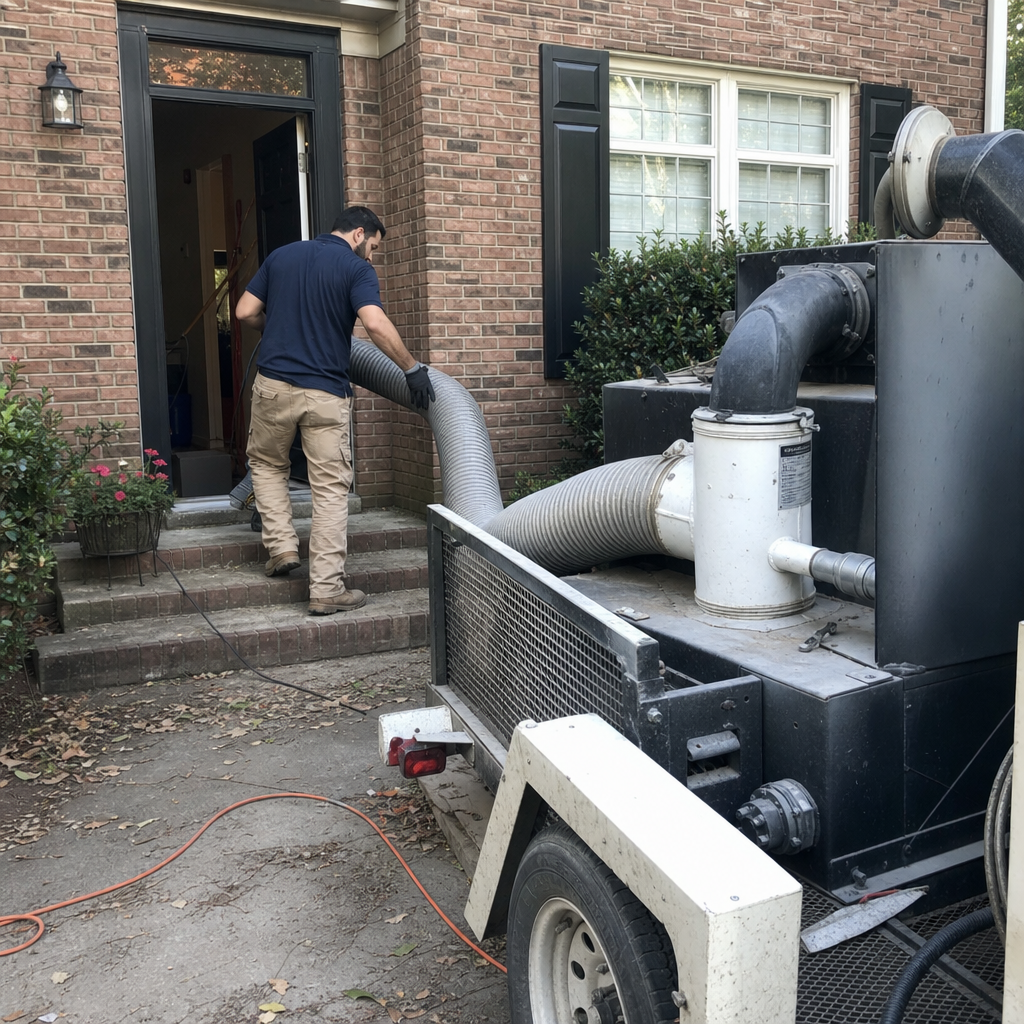
If they answer “professional-grade equipment” or “industrial-strength vacuums,” press harder. Legitimate contractors name brands and methods: Rotobrush contact-cleaning systems for mechanical agitation, Nikro HEPA vacuums for negative pressure extraction, Abatement Technologies air scrubbers for containment. We use these exact systems because they’re specified for commercial remediation work — the same standard we apply to Atlanta homes.
Ask about negative pressure specifically: “Will you maintain continuous negative pressure in the ductwork during cleaning, and what’s your minimum measurement in inches of water column?” A blank pause means you’re talking to a salesperson, not a technician. Professional equipment maintains 0.02 inches of water column minimum to prevent debris release into your home.
Question 3: “Will you provide a written scope of work before arrival, and what happens if you find additional contamination?”
The bait-and-switch depends on surprise “discoveries” at your door. A written scope with photographic documentation of accessible areas beforehand eliminates this. We provide this for every Atlanta job — it’s how we’ve maintained 433 verified reviews averaging 4.9 stars with no pattern of pricing complaints.
Be especially wary of any contractor who mentions “mold” during the initial phone call. Without lab sampling, visible inspection alone cannot confirm mold species or toxicity. This is a favorite pressure tactic in Atlanta’s humid climate, where harmless household dust can be made to look sinister.
What a Legitimate Pre-Job Walkthrough Looks Like
The walkthrough separates inspection from sales pitch. Here’s what each looks like:
Legitimate inspection:
- The technician asks about your home’s age, recent renovations, allergy concerns, and HVAC performance issues before entering the attic or crawlspace
- They photograph accessible trunk lines, registers, and the air handler with your permission
- They explain what they can and cannot access — some Atlanta homes built 1960-1985 have ductwork behind finished ceilings that can’t be reached without renovation
- They discuss realistic outcomes: “You’ll see reduced dust accumulation and improved airflow, but duct cleaning won’t fix an undersized system or leaking refrigerant”
- They provide a written proposal with exact scope, equipment specifications, and total price before any work begins
Sales pitch disguised as inspection:
- Immediate focus on “contamination,” “toxic buildup,” or health scare language without visual evidence
- Claims of mold without offering lab sampling or showing you the actual growth location
- Pressure to decide immediately: “This pricing is only good today” or “I can do it right now while I’m here”
- Refusal to provide written scope until after work begins
- Upsells presented as necessities: “The cleaning won’t work without sanitizing” or “Your system will recontaminate without this UV light”
In our experience across Atlanta neighborhoods from Midtown to Alpharetta, the technicians pushing hardest for immediate decisions are the least qualified to perform the actual work. Two decades of crawlspace-level experience goes into every inspection we perform — and that means telling homeowners when cleaning isn’t the right solution, not inventing problems to solve.
How to Evaluate a Before/After Proposal
A legitimate proposal includes measurable deliverables, not just promises of “cleaner air.” Here’s what to demand:
| Deliverable | What It Means | Red Flag If Missing |
|---|---|---|
| Pre-cleaning CFM (cubic feet per minute) readings at supply registers | Baseline airflow measurement showing restriction before cleaning | No quantified starting point means no proof of improvement |
| Camera footage of supply and return trunk lines | Visual documentation of contamination type and severity | Only register-level photos hide trunk line conditions |
| Post-cleaning CFM readings at same register locations | Documented airflow improvement, typically 15-40% in restricted systems | Vague claims of “better airflow” without numbers |
| Post-cleaning camera footage of same trunk line sections | Visual proof of debris removal | Before/after from different angles or locations |
| Waste disposal documentation | Proof debris was removed from property, not just relocated | No mention of debris handling or disposal |
We provide this documentation on every HVAC Cleaning in Atlanta job because it’s how we prove our work. In twenty years, we’ve learned that Atlanta homeowners with allergy sufferers or recent renovations — common in booming areas like West Midtown and the Eastside Beltline corridor — need this verification most.
Be skeptical of contractors promising specific health outcomes. Duct cleaning improves HVAC efficiency and reduces circulating dust and allergens, but no ethical contractor guarantees asthma relief or allergy elimination. The EPA and NADCA both caution against health claims that can’t be clinically verified.
Contract Language to Require Before Signing
Your written agreement should specify these elements precisely:
Scope of access points: “Contractor shall clean all accessible supply and return ductwork, registers, grilles, and the air handler cabinet. Inaccessible areas behind finished walls or ceilings are excluded unless specifically noted.” This prevents the “we couldn’t reach that” excuse after payment.
Equipment specifications: “Cleaning shall be performed using mechanical agitation (specify: Rotobrush or equivalent) combined with HEPA-filtered negative pressure extraction (specify: Nikro or equivalent) maintaining minimum 0.02 inches water column throughout the process.” Generic “professional equipment” language invites corner-cutting.
Contingency protocol: “If additional contamination is discovered beyond the scope of this agreement, contractor shall stop work, document findings photographically, and obtain written authorization for additional work before proceeding. No additional charges shall be incurred without homeowner signature.” This single clause eliminates most bait-and-switch tactics.
Protection of property: “Contractor shall protect flooring, furnishings, and finishes using drop cloths and corner guards. Any damage caused by contractor’s equipment or personnel shall be repaired at contractor’s expense.” Atlanta’s historic homes in Druid Hills, Ansley Park, and Decatur often have original hardwood and plaster that require careful handling.
Completion verification: “Upon completion, contractor shall provide post-cleaning CFM readings, camera documentation, and waste disposal receipt before final payment is due.” This ensures you receive proof of work before releasing funds.
From dirty ducts to repaired, sealed, and sanitized — we handle the full scope. Our contracts reflect this completeness because we’ve seen too many Atlanta homeowners need a second company to fix what a cheap cleaning damaged or missed.
Common Mistakes to Avoid
- Choosing by price alone. The $49-$99 whole-house special is mathematically impossible for legitimate work. A single technician with proper equipment, travel time, and disposal costs cannot operate profitably at this price without upselling. In Atlanta’s traffic, just reaching a Buckhead or Johns Creek home consumes significant labor cost.
- Trusting online reviews without reading patterns. Check for repeated complaints about pricing surprises, not just star averages. Look for reviews mentioning specific technicians by name — anonymous “great service” posts with no details often indicate purchased or incentivized feedback. Our 433 reviews include hundreds naming Scott Gray specifically.
- Scheduling without verifying who’s actually coming. Many Atlanta “duct cleaning companies” are lead-generation services that sell your information to the lowest-bidding subcontractor. Confirm the person who answers your call is employed by the company performing the work.
- Ignoring Atlanta’s pollen season timing. March through May, contractors are overwhelmed and some cut corners. Schedule cleaning in fall or winter when technicians can spend proper time on each job. If you must schedule during pollen season, expect longer lead times and don’t accept rushed work.
- Assuming HVAC companies automatically do quality duct work. Generalist HVAC contractors often treat duct cleaning as a loss-leader to sell equipment replacements. Their technicians may lack specific duct cleaning training or proper equipment like Rotobrush systems and Nikro HEPA vacuums.
- Neglecting dryer vent cleaning simultaneously. In Atlanta’s humid climate, lint buildup accelerates and creates fire hazards. A legitimate contractor should inspect and offer Dryer Vent Cleaning in Atlanta as part of a complete home air system evaluation.
- Paying upfront for “mold remediation” without lab confirmation. Any contractor claiming mold and demanding immediate payment for treatment is operating outside professional standards. NADCA requires lab sampling for mold identification; visual assessment alone is insufficient.
When to Call a Professional
Call a professional duct cleaning contractor when you notice visible dust emission from registers, persistent musty odors when HVAC runs, uneven heating or cooling between rooms, or significantly higher energy bills without weather explanation. After any home renovation — especially common in Atlanta’s booming intown neighborhoods — duct cleaning removes construction debris that infiltrates even sealed systems. Homes with pets, allergy sufferers, or residents with respiratory conditions benefit from more frequent evaluation.
433 neighbors have rated us 4.9 stars — the numbers speak for themselves. Everest Air Duct Cleaning Service Georgia offers free estimates in Atlanta — call (877) 565-7296. Scott Gray personally evaluates every project and provides the written scope, equipment specifications, and measurable deliverables described in this guide.
Frequently Asked Questions
Legitimate whole-system duct cleaning in Atlanta typically ranges from $400 to $900 for a standard single-system home, depending on accessibility, system size, and contamination level. The $49-$199 specials are bait-and-switch operations that average $400-$800 in upsells once inside. Call (877) 565-7296 for an exact quote — estimates are free.
Every three to five years for typical Atlanta homes, but more frequently if you have pets, allergy sufferers, or have completed renovations. Our humid climate and intense pollen seasons accelerate buildup compared to drier regions. Homes near major construction — common in booming areas like Westside Atlanta and Gwinnett County — may need more frequent evaluation due to airborne debris.
Duct cleaning addresses the distribution network (supply and return ducts, registers, grilles). HVAC cleaning includes the air handler components: blower motor, evaporator coils, and drain pan. We perform both because dirty components recontaminate clean ducts immediately. A contractor cleaning only ducts while ignoring a fouled evaporator coil is selling you half a solution.
Yes, but modestly — typically 5-15% improvement in systems with significant airflow restriction. The primary benefit is HVAC longevity: reduced strain on blower motors and compressors. In Atlanta’s extreme summer heat, every efficiency gain matters, but duct cleaning won’t fix fundamentally undersized or aging equipment.
No — NADCA membership is voluntary nationwide, including Georgia. This makes independent verification essential. Georgia’s HVAC contractor licensing doesn’t automatically include duct cleaning expertise. Always verify NADCA membership directly at NADCA.com rather than trusting website claims.
Legitimate mold concerns require laboratory sampling and species identification, not visual assessment alone. Any contractor claiming “toxic black mold” without sending samples to a lab is using scare tactics. We use Abatement Technologies containment protocols when mold is suspected, but we never diagnose or treat without proper testing. Call (877) 565-7296 if you’re concerned — we’ll explain the proper verification process.
The Bottom Line
Hiring a legitimate air duct cleaning contractor in Atlanta requires active verification, not passive trust. Check NADCA membership independently. Ask the three phone questions about pricing structure, equipment specifics, and written scope. Demand measurable deliverables — CFM readings and camera documentation — in your contract. Require contingency language preventing mid-job price escalation. The $49 special isn’t a deal; it’s a business model built on deception in a market where honest work costs what it costs. We use Rotobrush contact-cleaning and Nikro HEPA extraction — the same equipment trusted in commercial remediation — because Atlanta homeowners deserve that standard in their homes.
Written by Scott Gray, Owner & Lead Technician at Everest Air Duct Cleaning Service Georgia, serving Atlanta since 2006.