
Last updated July 11, 2026
Air Duct Cleaning Permits, Codes & Inspections in GA: What You Need to Know
Here’s a scenario we’ve encountered dozens of times in Atlanta homes: a duct cleaning crew finishes the job, notices a disconnected trunk line in your Sandy Springs attic, and offers to “seal it up while we’re here” for an extra $150. No paperwork, no permit, no licensed contractor on site. Six months later, your HVAC fails during a July heat wave, water damage spreads through your ceiling, and your insurance adjuster denies the claim because unlicensed mechanical work voided your policy’s workmanship clause. At Everest Air Duct Cleaning Service Georgia home, we’ve spent 20 years navigating the boundary between routine cleaning and regulated mechanical work — and that line is blurrier than most homeowners realize. This guide breaks down exactly where Georgia law draws it, which licenses matter, and how to protect yourself before anyone climbs into your attic.
Quick Answer
Routine air duct cleaning in Georgia does not require a permit or licensed contractor. However, any duct repair, sealing of disconnected components, trunk line modification, or system alteration triggers Georgia’s mechanical code requirements and must be performed by a licensed Conditioned Air Contractor with proper permitting and inspection. The dividing line is “cleaning versus changing” — if the physical configuration of your ductwork is altered, codes apply.
Table of Contents
- Where Cleaning Ends and Code Requirements Begin
- Georgia’s Conditioned Air Contractor Licensing Structure
- The Georgia State Mechanical Code: Specific Boundaries
- How Atlanta-Area Jurisdictions Handle Inspections Differently
- Post-Remediation Duct Work: A Different Regulatory Path
- The Paper Trail Homeowners Need for Future Sales
- Common Mistakes to Avoid
- When to Call a Professional
- Frequently Asked Questions
Where Cleaning Ends and Code Requirements Begin
The distinction sounds simple until you’re standing in a Brookhaven crawlspace watching a technician debate whether a sagging flex duct needs re-securing. Here’s how Georgia actually defines the boundary:
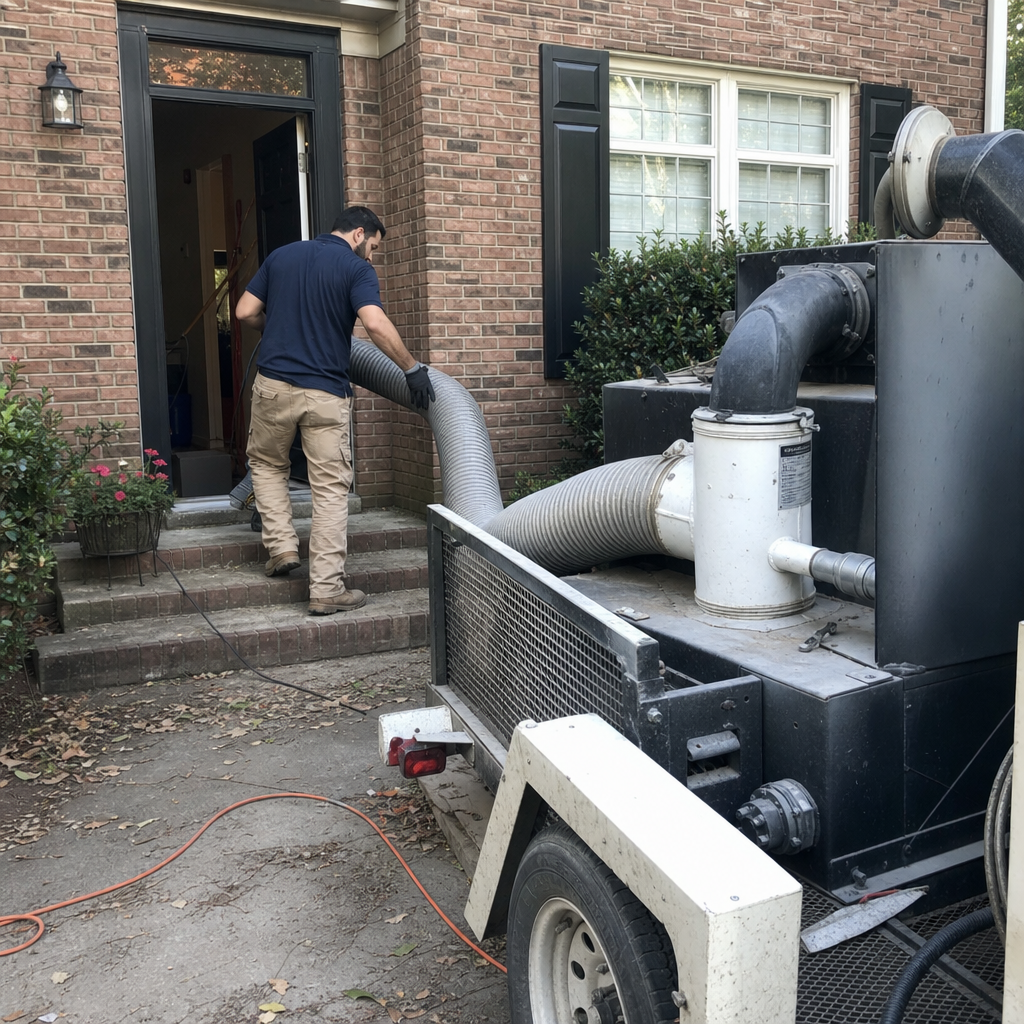
Cleaning (no permit required): Mechanical removal of dust, debris, and contaminants from existing duct surfaces using brushes, compressed air, or vacuum extraction. This includes agitation of interior surfaces and extraction with HEPA-filtered equipment like the Nikro systems we deploy on Atlanta jobs. Sanitizing with EPA-registered products applied without altering duct structure also falls here.
Repair/Modification (permit and licensed contractor required): Reconnecting disconnected ductwork, sealing gaps with mastic or tape in a way that changes airflow patterns, replacing damaged sections of trunk lines, modifying register locations, or altering the return air path. Even “minor” sealing of substantial leaks crosses this threshold when it restores or changes designed airflow.
We’ve seen this confusion play out repeatedly in Atlanta’s older neighborhoods — Virginia-Highland bungalows with 1960s galvanized ductwork, Decatur ranch homes with deteriorating fiberboard trunks. A well-meaning cleaner spots a problem, fixes it without proper licensing, and creates liability the homeowner discovers years later. The Georgia Secretary of State’s office, which oversees the Conditioned Air Contractors licensing board, has issued multiple consent orders against companies performing unlicensed duct modifications after cleaning appointments.
The critical question to ask any technician: “Are you altering the physical duct configuration, or only cleaning its interior surfaces?” If there’s any hesitation, pause the work and verify credentials.
Georgia’s Conditioned Air Contractor Licensing Structure
Georgia doesn’t use a single “HVAC license.” The Division of Conditioned Air Contractors, operating under the Secretary of State’s Professional Licensing Boards division, maintains three distinct classes — and only two authorize the duct modification work that frequently follows cleaning discoveries.
Class I — Conditioned Air Contractor (Unrestricted)
This is the full mechanical contractor license. Holders can install, maintain, repair, and alter any conditioned air system, including complete duct system design and modification. A Class I licensee must have four years of documented experience, pass a comprehensive examination, and maintain general liability insurance and worker’s compensation coverage. In our experience across Atlanta, this is the credential required for any substantial duct repair or replacement work discovered during cleaning.
Class II — Conditioned Air Contractor (Restricted)
Class II limits work to systems of 25 tons cooling capacity or 500,000 BTU heating capacity — sufficient for virtually all residential applications in Atlanta’s market. The experience requirement drops to two years. For typical Atlanta single-family homes in Buckhead, Midtown, or the suburbs, a Class II license fully covers duct repair and modification work. This is the most common residential credential, and it’s what homeowners should verify when a cleaning reveals needed repairs.
Class III — Conditioned Air Contractor (Maintenance)
Here’s where homeowners get caught. Class III authorizes only maintenance — cleaning, filter changes, belt adjustments, and minor component lubrication. Critically, it does not permit duct repair, sealing of disconnected components, or system modification. Yet Class III holders frequently perform this work, especially when attached to cleaning companies operating as “full service” duct operations.
We’ve encountered this in Atlanta’s competitive market more often than we’d like. A company advertises duct cleaning, discovers “a few repairs needed,” and sends a Class III technician to perform them. The work might look fine. It might function adequately through Atlanta’s pollen-heavy springs and humid summers. But it’s unlicensed, unpermitted, and potentially uninsurable.
Verification is straightforward: Georgia’s online license lookup shows the class held by any contractor. Ask for the license number, check it yourself, and confirm the class matches the work proposed.
The Georgia State Mechanical Code: Specific Boundaries
Georgia operates under a state-modified version of the International Mechanical Code (IMC), with amendments adopted through the Georgia Department of Community Affairs. For duct work, the relevant provisions center on Chapter 6 (Duct Systems) and permitting requirements in Chapter 1.
The code explicitly exempts “cleaning and maintenance of existing systems” from permit requirements under Section 105.2. However, it mandates permits for “repair or replacement of duct systems” under Section 105.1, with specific trigger thresholds:
- Replacement of more than 10 linear feet of any duct run requires full permitting and inspection.
- Modification of trunk lines — the main supply or return plenums — requires permitting regardless of length.
- Sealing of disconnected components that restores designed airflow patterns constitutes “repair” under the code’s definitions, not maintenance.
- Alteration of register or grille locations requires permitting as it changes the engineered distribution system.
Atlanta’s climate creates specific code considerations that northern Georgia jurisdictions handle differently. The code’s duct sealing requirements (Section 603.9) reference ASHRAE standards for duct leakage — standards that become critical in Atlanta’s cooling-dominated climate, where duct leakage to unconditioned attics can waste 30% or more of cooling energy. When we perform Air Duct Cleaning in Atlanta and identify significant leakage, we document it thoroughly and refer to licensed Class I or II contractors for the repair work, maintaining the regulatory separation that protects our customers.
The code also references Georgia’s energy code (International Energy Conservation Code with state amendments), which mandates duct sealing and testing for new systems and substantial replacements. Post-cleaning repairs that exceed the 10-foot threshold trigger these energy code requirements as well, adding blower door or duct blaster testing to the inspection process.
How Atlanta-Area Jurisdictions Handle Inspections Differently
Georgia’s state mechanical code sets minimum standards, but local jurisdictions add layers — and Atlanta’s patchwork of city, county, and unincorporated areas creates genuine confusion. Here’s what we’ve learned from two decades of working across these boundaries:
Fulton County (Inside Atlanta City Limits)
The City of Atlanta’s Office of Buildings handles permitting and inspection for duct work requiring permits. Their mechanical inspectors verify licensed contractor status, examine duct sizing against Manual D calculations for modifications, and require pressure testing for substantial replacements. Turnaround times typically run 3-5 business days for permit issuance, with inspections scheduled within 48 hours of completion. We’ve found their inspectors particularly attentive to flex duct support spacing and mastic application quality — details that matter in Atlanta’s hot attics where sagging ducts collect condensation.
Fulton County (Unincorporated Areas)
North of the city limits — Sandy Springs, Johns Creek, Milton, and unincorporated pockets — Fulton County’s Department of Public Works Building Division holds jurisdiction. Their process mirrors Atlanta’s but with longer inspection lead times, typically 5-7 business days. A critical difference: unincorporated Fulton requires contractor registration in addition to state licensing, a step some out-of-county contractors miss. Homeowners in these areas should verify both state license and county registration before work begins.
DeKalb County
DeKalb’s Building Permits and Inspections division maintains stricter documentation requirements for mechanical work. They require submitted duct layouts for any trunk line modification, not just replacement. For homeowners in Decatur, Druid Hills, or unincorporated DeKalb, this means repair work following cleaning discoveries takes longer to permit but receives more thorough inspection scrutiny. DeKalb also enforces stricter energy code compliance testing, requiring duct leakage tests for repairs exceeding 25% of system ductwork.
Cobb, Gwinnett, and Cherokee Counties
These rapidly growing metro counties have streamlined processes reflecting their building booms. Cobb County permits most residential duct repairs over the counter with same-day issuance. Gwinnett requires online submission but offers next-day inspection scheduling. Cherokee, with more rural unincorporated areas, still permits some duct work through faxed applications — an anachronism that surprises Atlanta transplants.
The jurisdiction question matters for homeowners because inspectors verify contractor licensing at the point of permit application. An unlicensed contractor can’t obtain a permit in any of these jurisdictions — meaning work performed without a permit was either done by an unlicensed operator or bypassed inspection entirely. Both scenarios create the insurance exposure we flagged in our opening.
Post-Remediation Duct Work: A Different Regulatory Path
Atlanta’s humid subtropical climate — 50+ inches of annual rainfall, summer dew points regularly exceeding 70°F — creates mold and moisture issues that routine cleaning doesn’t address. When duct work follows mold remediation, water damage restoration, or sewage backup, Georgia’s regulatory framework shifts significantly.
The Georgia Department of Public Health’s Indoor Air Quality program, while not a permitting authority, provides guidance that many Atlanta-area jurisdictions incorporate by reference. Post-remediation duct work falls under two overlapping requirements:
- Industrial Hygienist Clearance: For Category 2 or 3 water damage (gray or black water), or any mold remediation exceeding 10 square feet, the Georgia Mold Assessment and Remediation Act requires clearance testing by a licensed industrial hygienist before ducts are returned to service. This isn’t optional — it’s a statutory requirement that applies regardless of whether duct work itself required permitting.
- Documentation Chain: Remediation contractors must provide a written scope of work, post-remediation verification from the hygienist, and confirmation that HVAC systems were properly isolated during remediation. Duct cleaning performed after remediation without this documentation may be rejected by insurers if future claims arise.
We’ve worked with Atlanta remediation contractors in Buckhead high-rises, Midtown historic conversions, and Decatur basements where this documentation proved critical. In one Virginia-Highland case, a homeowner’s post-remediation duct cleaning lacked hygienist clearance; when mold recurred two years later, their insurer denied the $18,000 claim citing incomplete documentation from the original event.
The equipment matters here too. Post-remediation duct cleaning requires HEPA containment and negative air pressure — capabilities that distinguish professional-grade systems like our Abatement Technologies air scrubbers from standard residential cleaning equipment. We maintain this capability specifically because Atlanta’s climate generates enough remediation-adjacent work to justify the investment.
For homeowners navigating this path: request the hygienist’s clearance report before scheduling any post-remediation duct work, and ensure your cleaning contractor can document HEPA filtration and containment protocols. The combination protects both health and future insurability.
The Paper Trail Homeowners Need for Future Sales
Georgia’s seller disclosure requirements (O.C.G.A. § 44-1-16) mandate disclosure of “material defects” in residential property condition, including HVAC systems. Duct work performed without proper permitting or licensing becomes a material defect if discovered during buyer inspections — and in Atlanta’s competitive market, buyers’ agents increasingly request documentation of mechanical system work.
Here’s what we advise homeowners to maintain, based on two decades of seeing these issues surface at closing:
- Original scope of work from any duct cleaning or repair contractor, with clear delineation of cleaning-only versus repair work performed
- Contractor license verification — screenshot or printout from Georgia’s online lookup showing active status and correct class
- Permit documentation for any repair or modification work, including final inspection sign-off
- Equipment documentation if sanitizing or air quality products were installed — EPA registration numbers for sanitizers, product specifications for installed equipment like Honeywell or Aprilaire systems
- Post-remediation clearance reports where applicable, with industrial hygienist license number
- Before/after photography of accessible duct work, particularly for repairs in attics or crawlspaces that buyers’ inspectors won’t fully visualize
Atlanta’s real estate market moves fast — average days on market in desirable intown neighborhoods often measure in single digits. Sellers without this documentation face delayed closings, repair credits, or deals renegotiated under inspection contingencies. The $200 permit and inspection fee for proper repair work pales against a $15,000 closing concession demanded by a buyer’s attorney who discovered unpermitted attic duct modifications.
At Everest, we provide written scope documentation for every HVAC Cleaning in Atlanta we perform, clearly noting where cleaning ended and where we recommended licensed contractor referral for any discovered issues. This protects our customers and distinguishes our process from crews who blur the line to capture additional revenue.
Common Mistakes to Avoid
- Assuming “duct cleaning” companies can legally perform repairs. Georgia licenses duct cleaning as a maintenance activity; repair requires separate conditioned air contractor credentials. Verify before authorizing any work beyond interior surface cleaning.
- Accepting verbal assurances about licensing. We’ve encountered Atlanta-area technicians who confidently claim “full HVAC licensing” while holding only Class III maintenance credentials. The 30-second online verification prevents costly assumptions.
- Ignoring jurisdiction boundaries. A contractor properly permitted in unincorporated Fulton may lack required Atlanta city registration for work inside city limits. The address of your property determines jurisdiction, not the contractor’s office location.
- Skipping documentation for “minor” repairs. Even small trunk line sealing jobs create permit triggers if they restore designed airflow. The homeowner who doesn’t document properly becomes responsible if future issues arise.
- Permitting post-remediation work without hygienist clearance. Atlanta’s humidity means mold recurrence is common; incomplete documentation chains give insurers grounds to deny subsequent claims.
- Assuming new construction standards apply to existing homes. Georgia’s energy code testing requirements for new duct systems don’t automatically apply to repairs, but some jurisdictions enforce them for substantial replacements. Clarify with your local building department before work begins.
When to Call a Professional
Certain scenarios in Atlanta homes consistently cross the line from cleaning to regulated work: visible disconnected ducts in attic or crawlspace inspections, rusted or collapsed trunk lines common in 1960s-1980s construction, modifications following HVAC system replacement where new equipment mismatches existing duct sizing, and any work following water damage or mold remediation with potential Category 2/3 contamination.
When we encounter these situations during our inspections, we stop, document, and refer — maintaining the regulatory boundary that protects our customers. Scott Gray has worked every job for 20 years — your home gets the owner, not a substitute. 433 neighbors have rated us 4.9 stars — the numbers speak for themselves. We use Rotobrush contact-cleaning and Nikro HEPA extraction — the same equipment trusted in commercial remediation. From dirty ducts to repaired, sealed, and sanitized — we handle the full scope through our network of licensed Class I and II contractor partners.
Everest Air Duct Cleaning Service Georgia offers free estimates in Atlanta — call (877) 565-7296. We’ll assess your system, clearly distinguish cleaning needs from repair requirements, and ensure any necessary regulated work connects you with properly licensed, permitted, and inspected solutions.
Frequently Asked Questions
No. Routine air duct cleaning — the mechanical removal of dust and debris from existing duct interiors — is classified as maintenance under Georgia’s mechanical code and requires no permit or licensed contractor. However, if any repair, reconnection, or modification of ductwork is performed during the same visit, permitting and licensing requirements may apply. Call (877) 565-7296 for a free estimate and we’ll clarify exactly what your system needs.
Visit the Georgia Secretary of State’s online license lookup at verify.sos.ga.gov, enter the contractor’s license number or business name, and confirm the license class displayed. Class I or II authorizes repair and modification work; Class III permits only maintenance activities including cleaning. The lookup shows current status, expiration date, and any disciplinary history — check all three before authorizing work.
Cleaning addresses interior surfaces only; repair alters physical configuration or restores designed airflow. Atlanta and Fulton County building officials interpret reconnection of disconnected ducts, trunk line sealing that changes airflow patterns, and replacement of more than 10 linear feet as repair requiring permits. The specific work performed determines classification, not the contractor’s marketing description.
Properly performed cleaning by qualified technicians does not void manufacturer warranties. However, unlicensed repair work performed during cleaning visits — especially modifications to duct connections, sealing methods, or airflow balancing — can void both HVAC equipment warranties and homeowner’s insurance coverage for subsequent claims. Document contractor credentials and scope of work to protect yourself.
Georgia’s mold regulations require a licensed industrial hygienist’s clearance report before restored HVAC operation, the remediation contractor’s written scope of work, verification of proper HVAC isolation during remediation, and documentation of cleaning contractor HEPA containment protocols. Maintain these records for minimum seven years — they’re frequently requested in Atlanta real estate transactions and insurance claims.
Permits typically expire 180 days from issuance if work hasn’t commenced, with one 180-day extension available in most Atlanta-area jurisdictions. Once work begins, inspections must occur within specific windows — rough inspection before concealment, final inspection within 30 days of completion. Fulton County and Atlanta both enforce these timelines strictly; DeKalb County offers limited extensions for weather delays common to Atlanta’s thunderstorm season.
The Bottom Line
Georgia’s regulatory framework for duct work creates a clear but frequently crossed boundary: cleaning is maintenance, repair is construction. The distinction matters for permits, licensing, insurance coverage, and future home sale disclosures. Atlanta’s specific jurisdictional patchwork — city, county, and unincorporated areas with differing requirements — adds complexity that rewards informed homeowners. The essential protections are straightforward: verify contractor license class through Georgia’s official lookup, demand clear scope documentation separating cleaning from repair, obtain permits and inspections for any modification work, and maintain complete records. These steps transform a potentially liability-creating service encounter into properly documented home maintenance — the standard we apply to every Dryer Vent Cleaning in Atlanta and duct service we perform.
Written by Scott Gray, Owner & Lead Technician at Everest Air Duct Cleaning Service Georgia, serving Atlanta since 2006.